Visual Ethics
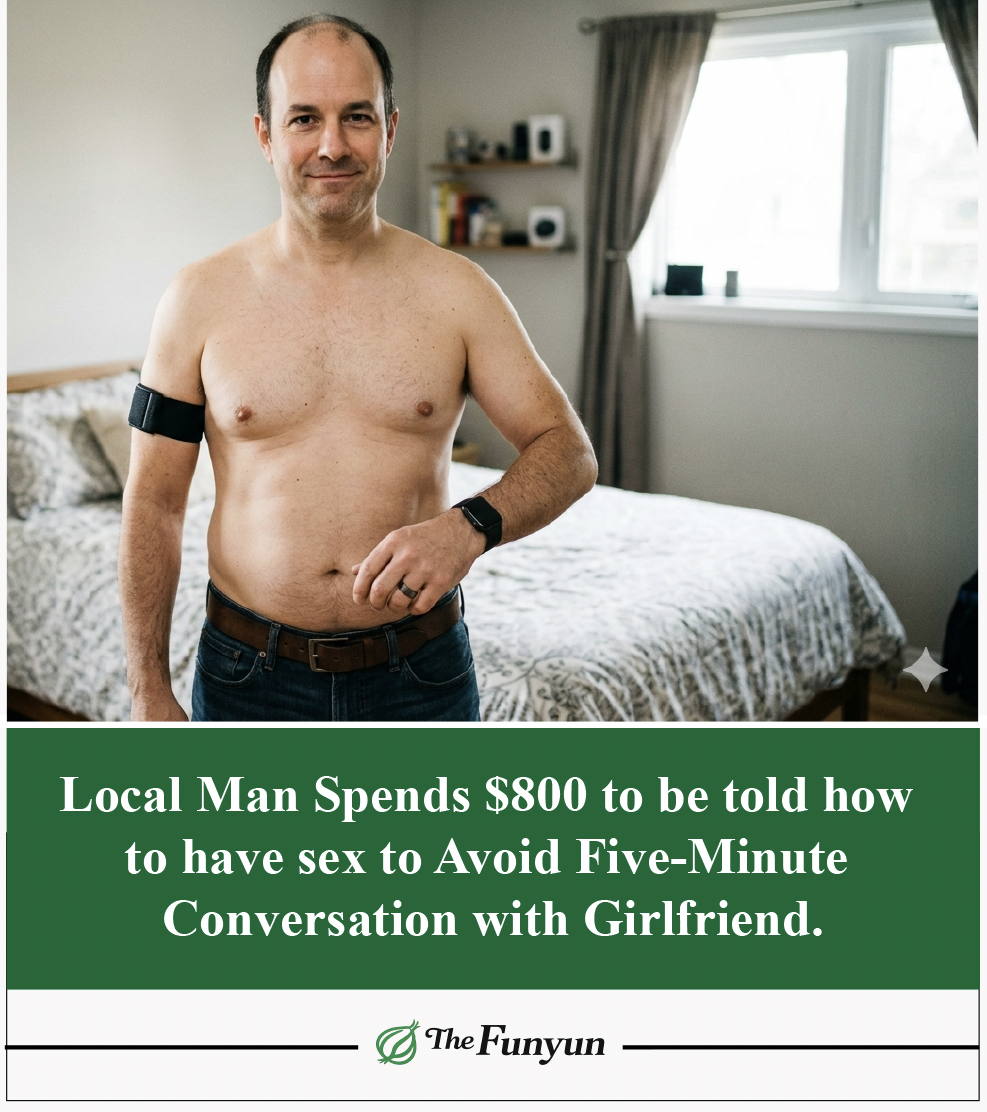
ATLANTA—Local resident and “data-maximalist” Mark Thompson was reportedly interrupted by a high-pitched “Performance Correction Notification” from his Peak-Pro™ at 11:42 PM Tuesday, notifying him that he was failing to provide a “statistically significant” amount of pleasure to his partner.
Thompson, who wears the Peak-Pro™ armband—a new wearable health monitor on the market—is synced not only to his Apple Watch but also to his iPhone and Oura Ring, ensuring no intimate moment goes un-audited. Thompson expressed confusion as to how the device reached its conclusion. “I’m doing all the things I can think of. The band doesn’t have a camera, but it somehow knew my girlfriend was internally planning the details of her upcoming girls’ trip while I was attempting to be intimate,” pointing out the ‘Enthusiasm’ flatline on his iPhone.
His girlfriend sat on the bed beside him, her face frozen in a look of silent, internal screaming, staring ahead. Thompson remained focused on the data. He detailed, the band vibrated his bicep with a pop-up on his smartphone: “Warning: Partner Boredom Detected. Efficiency at 14%. Upgrade to Peak-Pro+ for a ‘Satisfaction Upgrade’ or watch this 30-second ad for generic mood-stabilizing gummies.” Thompson expressed enthusiasm for the Same-Hour Delivery™ option.
Designed to turn human vulnerability into “relationship deliverables,” the Peak-Pro™ interface now automatically prompts users to share their humiliating ‘Sync Scores’ directly to their LinkedIn profile under the #GrowthOpportunities. “It’s deeply demoralizing to have a piece of titanium tell you that your girlfriend is faking an orgasm,” Thompson admits. “But the app says if I buy the Empathy+ subscription, it might finally give me the tools I need to anticipate when she’ll finally be motivated to meet my needs.
The Process
For this assignment, I immediately thought to reproduce a post from The Onion—my favorite satire news source. I went to their Instagram and read many of the titles to find similarities in tone and create the headline for the idea I had. The Onion mimics the authoritative tone of a high-end news organization and applies it to topics that are either completely ridiculous or painfully mundane.
To create this fictitious photo, I uploaded my story and asked Gemini to create a photo depicting what it thought was happening. It initially generated this photo:
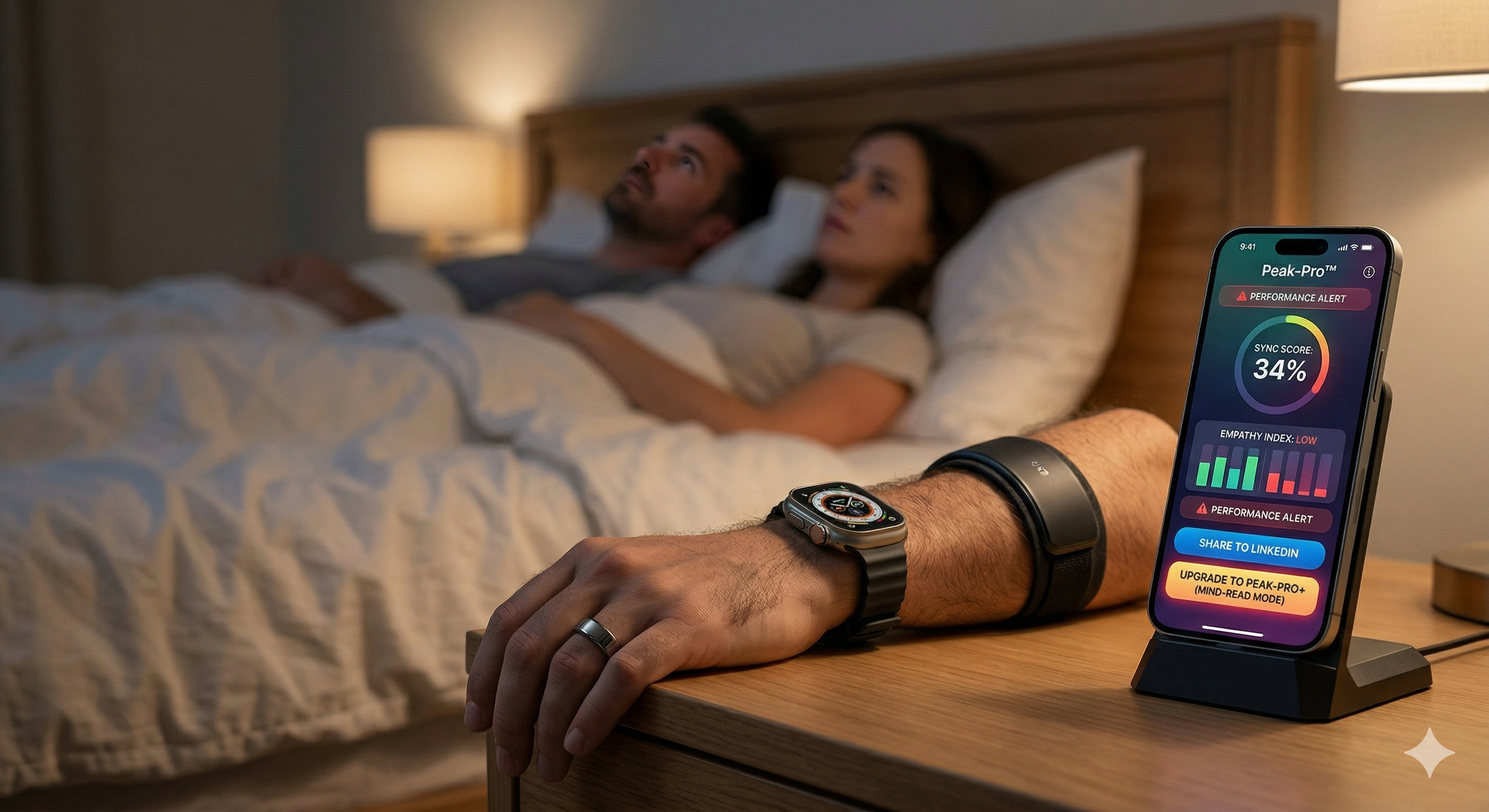
A photo of a couple in bed together, lying side-by-side, blurred in the background, then oddly, some random arm with all the tech resting on a bedside table in the foreground, next to a phone propped up to show some sort of metrics on a perceived application. So, I changed the prompt to ask for “a man wearing an Apple Watch, an Oura Ring, and an armband on his bicep that looks like a health monitor. Place him in his bedroom, shirtless, viewed from the waist up.”
I continued working with the prompt to get the image I thought best represented the photo style The Onion typically posts with its stories. I am pleased with his facial expression and stance as he looks proud of all that he does to hack his body. I wanted to highlight the contrast between his outward presentation as a ‘high-performer’ and the reality that he would rather throw money at gadgets than put in the actual work to improve his relationship. It captures the irony of a man who is ‘optimizing’ everything except his own ability to communicate.
Four Unethical Points
Something that I’ve been focused on lately is ‘rest as a form of resistance’. I find myself surrounded with people at my gym, and within the tech I personally have, telling me that I need to use various products to track my sleep to tell me… what? That I’m tired? That I’m not enough? That I’m overweight because I don’t get a certain number of steps in? The makers of wearable tech effectively communicate that data from a plastic band is more trustworthy, real, and important than a person’s ability to check in with themselves, not to mention, to always be ‘on’ and available. This image reminds us that this high-tech “bio-hacking” is taking place in what should be a private, safe, human-centered space. Essentially, we begin to view both ourselves and our partners as underperforming assets rather than human beings.
Furthermore, the image is designed to create a visual lie by “product-stacking.” At first glance, the audience looks at this guy and may think, “Whoa, he really knows something about longevity that I don’t,” or maybe “he is really into biohacking.” The image places a fictional device (the Peak-Pro band) right next to real-world, widely trusted health technology (the Apple Watch, iPhone, and the Oura Ring). This is a deceptive visual strategy where the fake device borrows the “truth” and credibility of the real ones. A viewer who sees the recognizable Apple Watch is visually primed to accept the creepy Peak-Pro band as just another legitimate, scientific health tool that exists on the market.
Not only that, but the imagined app’s interface is designed to exploit emotional vulnerability for profit. By displaying commercial prompts like “Upgrade to Peak-Pro+ for a ‘Satisfaction Upgrade’” and the gummy ad at the exact moment where some may deem a deeply personal relationship failure, the communication turns a human problem of lack of connection into a monetization opportunity. This is unethical because it suggests that if you are “failing” your partner, the solution is not conversation or empathy but spending money on a corporate “solution.”And finally, the image’s very existence is an example of communication in a news context. It is an image of a real-looking man in a real-looking room, but neither is real. It is a lie, created to manipulate the viewer’s belief in the story. Additionally, using a computer-generated model (and potentially likenesses of real people found in the AI’s training data without their consent) to validate a product and relationship dynamic that are total fabrications borrows the authenticity of a photo to sell a lie.
